
Most businesses treat digital marketing and website development as two separate projects managed by two separate teams — often hired at different times, with little communication between them. The website gets built first. Then, months later, a digital marketing agency is brought in to “drive traffic” to it.
This approach is exactly why so many Indian businesses have beautiful websites generating almost no business. The website was built without considering how traffic would arrive, how visitors would be captured, or how data would be measured. Adding marketing to a website that was not built for it is like installing a high-performance engine in a car with no steering wheel.
This guide explains how to integrate digital marketing and website development from the very first stage — so that your website is not just a digital brochure but a genuine, measurable revenue-generating asset.
Why Digital Marketing and Website Development Must Be Planned Together
The decisions made during website development directly determine the effectiveness of every digital marketing channel you will ever use:
- SEO: URL structure, page speed, heading hierarchy, and schema markup — all development decisions — determine whether your pages can rank on Google
- Google Ads / PPC: Landing page load speed, conversion form placement, and CTA design — development choices — determine your Quality Score and cost-per-click
- Social Media Marketing: Open Graph tags and meta image tags — implemented during development — determine how your pages look when shared on Facebook, Instagram, and LinkedIn
- Email Marketing: Newsletter signup forms, lead magnet delivery systems, and email capture popups — all require development integration
- Analytics: Event tracking, goal setup, and conversion tracking — must be implemented in code to measure any of the above accurately
None of these can be retrofitted perfectly. They must be built in from the start.
6 Digital Marketing Channels Your Website Must Be Built to Support
- Organic SEO Traffic: Every page needs proper keyword targeting, fast loading, and a clear content structure — built during development, not fixed afterwards
- Google Ads / PPC: Landing pages need lightning-fast load times, single focused CTAs, and no distracting navigation — this is a development design decision
- Social Media: Open Graph tags, share buttons, and social proof widgets must be integrated during development to make social sharing work correctly
- Email Marketing: Signup forms, lead magnet delivery, and CRM integration must be built into the site — not added as clunky afterthoughts
- WhatsApp Marketing: In India specifically, a WhatsApp chat button and click-to-chat links on every page dramatically increase conversion from mobile visitors
- Referral Traffic: Easy sharing, compelling meta images, and fast-loading pages ensure that visitors who arrive from other websites have a great first experience
Stage 1: Strategy Before Development — The Marketing Brief Your Developer Needs
Before a developer writes a single line of code, your marketing strategy must be defined. Share this brief with your development team:
| Question | Why Your Developer Needs to Know |
|---|---|
| Who is your primary customer and what problem do they have? | Determines the messaging hierarchy, CTA placement, and content priorities on each page |
| What is the primary conversion goal? (Call, form, purchase, booking?) | Determines what gets built — contact forms, booking systems, eCommerce, WhatsApp buttons |
| Will you run Google Ads? | Dedicated, fast-loading landing pages with minimal navigation must be built separately from main site pages |
| Will you do email marketing? | Newsletter forms, lead magnet delivery pages, and email service provider integration must be planned |
| Which social platforms will you use? | Open Graph tags, share buttons, and social proof widget placements must be designed in |
| What will you measure as success? | Conversion tracking events, goal funnels, and analytics setup must be built into the site from launch |
Stage 2: Conversion Architecture — Building to Convert, Not Just to Impress
A conversion-optimised website and a beautiful-but-useless website can look almost identical to an untrained eye. The difference is in the architecture — how pages are structured to move visitors toward taking action.
The Conversion Framework Every Page Must Follow
- Attention: A clear, compelling headline that immediately confirms the visitor is in the right place. Answer “what is this?” in the first 5 seconds.
- Interest: A subheadline or intro that connects to the visitor’s specific problem or desire. Speak to them, not about you.
- Desire: Social proof — reviews, testimonials, logos of clients, results data. Show evidence that you deliver what you promise.
- Action: A clear, prominent call-to-action button that tells the visitor exactly what to do next. One primary CTA per page — not five different options that create decision paralysis.
Where to Place Calls to Action
- Above the fold on every key page — the visitor should see a CTA without scrolling
- At the end of every service description
- After every testimonial section
- In the header as a persistent button — “Get a Free Quote” or “Book a Call”
- As a sticky bar on mobile for easy access while scrolling
At ByteMinders Edutech, every website we develop goes through a conversion architecture review before design begins — ensuring the structure serves the business goal, not just the visual aesthetic.
Stage 3: Technical Marketing Integrations That Must Be Built In
1. Google Analytics 4 and Google Tag Manager
Install Google Tag Manager (GTM) on your website during development — not after launch. GTM acts as a container for all your marketing tags, making it easy to add and manage tracking without going back to your developer every time. Through GTM, implement:
- Google Analytics 4 tracking with conversion goals configured
- Google Ads conversion tracking for any PPC campaigns
- Facebook/Meta Pixel for social media remarketing
- Custom event tracking for key actions — form submissions, WhatsApp button clicks, phone number clicks, video plays
2. Open Graph and Twitter Card Meta Tags
When someone shares your webpage on Facebook, Instagram, LinkedIn, or Twitter/X, the platform pulls the image, title, and description from Open Graph meta tags. Without these, social shares look broken — a tiny thumbnail, the wrong title, or no image at all. Every page must have:
- og:title — the page title as it should appear when shared
- og:description — a 1 to 2 sentence description of the page
- og:image — a high-quality image at 1200×630 pixels (the optimal size for all major platforms)
- og:url — the canonical URL of the page
3. WhatsApp Integration (India-Specific Priority)
WhatsApp is the most used communication app in India. Every website built for an Indian audience must include:
- A floating WhatsApp chat button on every page (especially visible on mobile)
- Pre-populated message text so visitors can reach you with one tap: “Hi, I’m interested in your services”
- WhatsApp click tracking in Google Analytics so you can measure enquiries through this channel
4. Email Marketing Integration
- Newsletter signup forms on the homepage, blog sidebar, and at the end of blog posts
- Lead magnet delivery — if you offer a free guide, checklist, or ebook as a signup incentive, the delivery system must be set up during development
- Integration with your email service provider (Mailchimp, ConvertKit, or Zoho Campaigns are popular in India)
5. Landing Pages for Paid Campaigns
If you plan to run Google Ads or Meta Ads, build dedicated landing pages during the initial development — not as an afterthought when you start spending on ads. Effective landing pages for digital marketing and website development campaigns:
- Have no main navigation (to eliminate distraction and keep visitors focused)
- Load in under 2 seconds on mobile (slow landing pages kill Google Ads Quality Scores)
- Contain a single, clear offer and a single CTA
- Have a “thank you” page after form submission that Google Ads can use as a conversion trigger
The Digital Marketing Conversion Funnel Your Website Must Serve
- 🌐 Awareness & Traffic (Top): SEO blog content, Google Ads, social media, and referrals bring visitors to your site — your website must load fast and make an instant strong impression
- 💡 Engagement & Interest: Service pages, about page, and portfolio sections keep visitors engaged and answer their key questions — clear navigation and compelling content are essential
- ⭐ Trust & Desire: Testimonials, case studies, certifications, team profiles, and review widgets build the confidence a visitor needs before taking action
- 🎯 Conversion & Action (Base): Contact forms, WhatsApp buttons, booking systems, and purchase flows — the moment the visitor becomes a lead or customer
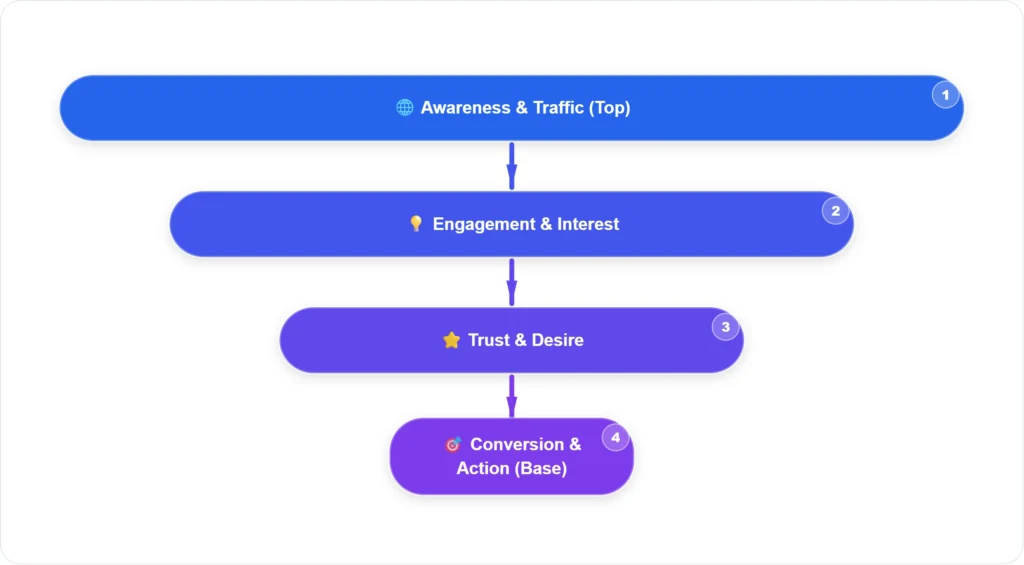
Most websites are strong at the top of the funnel (they attract traffic) but weak at the bottom (they fail to convert that traffic into leads). Building conversion into every page of the site from day one is what changes this.
Measuring What Works: The Analytics Setup Your Website Must Have at Launch
- Google Analytics 4: Installed via Google Tag Manager; goals configured for form submissions, phone clicks, and WhatsApp clicks
- Google Search Console: Connected to your website; sitemap submitted; performance tab monitored weekly for keyword rankings and CTR
- Google Ads Conversion Tracking: If running PPC campaigns, conversion events must be firing correctly before you spend your first rupee on ads
- Heatmap Tool: Microsoft Clarity (free) or Hotjar shows you where visitors click, how far they scroll, and where they drop off — invaluable for improving conversion rates
For a complete technical foundation to support all of this, also read our SEO-friendly website development technical checklist. And to understand the on-page elements specifically, our guide on on-page SEO for websites covers every element in practical detail.
Frequently Asked Questions
Q1. Should I plan my digital marketing strategy before or after building my website?
Before — always. Your digital marketing strategy should inform every major decision during website development: which pages to build, what conversion goals to set up, which integrations to implement, and how to structure content for SEO. Building the website first and asking a marketer to work with what exists is the most expensive way to approach this. The cost of retrofitting marketing into a poorly structured website almost always exceeds the cost of planning it correctly upfront.
Q2. How important is website speed for digital marketing performance?
Extremely important — across every channel. For SEO, slow page speed directly hurts Google rankings via Core Web Vitals. For Google Ads, slow landing pages reduce your Quality Score, increasing your cost-per-click. For social media traffic, slow load times cause mobile users to bounce before the page loads. For email campaigns, slow destination pages reduce the conversion rate of your emails. Speed is not just a technical metric — it is a direct revenue lever for every digital marketing channel.
Q3. What is the most important conversion element on a business website?
A clearly visible, compelling call to action above the fold on your homepage. Before a visitor reads a single sentence about your services, they should be able to see what action you want them to take. On mobile — where most Indian visitors arrive — this means a prominent button that works with a single thumb tap, ideally with your phone number visible and a WhatsApp contact option directly accessible.
Q4. Do I need a separate landing page for Google Ads or can I use my homepage?
You need dedicated landing pages for Google Ads. Your homepage serves multiple audiences with multiple messages — it is not optimised for conversion from a single ad campaign. A dedicated landing page matches the exact promise of your ad, eliminates navigation distractions, and focuses entirely on one action. This consistently produces 30 to 50% higher conversion rates than sending paid traffic to a homepage.
Q5. How long after launching a website should I start digital marketing?
Immediately — but with the right expectations per channel. Paid advertising (Google Ads, Meta Ads) can drive traffic from day one of launch. SEO-driven organic traffic typically takes 3 to 6 months to build meaningfully. Email marketing can begin as soon as your first subscribers sign up. Social media marketing can start before the website even launches, building an audience to direct to the site on launch day. The key is that your tracking and analytics must be set up and verified before you start spending any budget on paid channels.