
In 2026, when someone needs a lawyer in Lucknow, a physiotherapist in Surat, or an interior designer in Chennai — their first action is almost always the same: they open Google. If your service business does not have a strong digital website and digital presence, that customer goes to your competitor. Every single time.
Building a digital presence is not about being everywhere at once. It is about being highly visible in exactly the places your potential customers look — and making a strong, trust-building impression when they find you. This guide gives you the exact steps to build a complete, professional digital presence for your service business in 2026, starting from scratch if necessary.
What “Digital Presence” Actually Means for a Service Business
Digital presence is the sum of everywhere your service business appears online — your digital website, your Google Business Profile, your directory listings, your social media pages, your customer reviews, and any content you have published. Together, these signals tell potential customers that your business is real, credible, and worth contacting.
A strong digital presence has three qualities:
- Findable: People who are searching for your service in your city can discover you through Google search, Google Maps, or relevant directories
- Credible: When they find you, the combination of your website, reviews, and social presence immediately communicates professionalism and trustworthiness
- Convertible: Your online presence makes it easy for interested visitors to take the next step — call you, send a message, fill a form, or book an appointment
The 7-Step Staircase to a Complete Digital Presence
- Build Your Digital Website: Your owned online home — the foundation everything else references
- Google Presence Setup: Google Business Profile and Google Search Console — your search visibility foundation
- Directory Listings: Consistent NAP across JustDial, Sulekha, IndiaMart, and relevant niche directories
- Collect Reviews: Systematically gather Google reviews from every satisfied client — 20+ reviews within your first 3 months
- Publish Content: Service pages, blog posts, and FAQs that answer your audience’s questions and build organic search visibility
- Social Media: Professional profiles on the 1 to 2 platforms your clients actually use — quality over quantity
- Paid Advertising: Once the organic foundation is working, amplify with Google Ads or targeted social ads
Do not skip steps. Each one reinforces the ones below it. A social media ad campaign that sends traffic to a poorly built digital website wastes every rupee. Build from the bottom up.
Step 1: Build Your Digital Website — The Non-Negotiable Foundation
Your digital website is not just a page on the internet. It is your 24/7 salesperson, your credibility proof, and your lead generation engine. Here is what every service business website must include in 2026:
| Element | Why It Matters | Non-Negotiable Standard |
|---|---|---|
| Professional design | 75% of users judge credibility from website design | Custom or professionally customised — not generic free themes |
| Mobile responsive | 70%+ of Indian visitors come from smartphones | Perfect on all screen sizes — test on 3 real devices |
| Fast loading | 53% of mobile visitors leave if a page takes over 3 seconds | Google PageSpeed score ≥70 on mobile |
| Clear service pages | Visitors must understand what you do in under 10 seconds | Individual page per service, 500+ words, keyword optimised |
| Contact options | Friction reduces enquiries — make it effortless to reach you | Phone, WhatsApp button, contact form — all visible on every page |
| HTTPS (SSL) | Google marks non-HTTPS sites as “Not Secure” — kills trust | Mandatory — free via Let’s Encrypt |
| Google Analytics | Without data, you cannot improve what is not working | GA4 installed and goals configured on launch day |
For a complete guide to building your service business website, read our article on website development for small businesses: step-by-step guide to go live in 30 days.
Step 2: Set Up Your Google Presence
After your digital website is live, your Google presence is the second most important element. Two tools, both free:
Google Business Profile
This is what determines whether you appear in the map results when someone searches “your service near me”. A fully optimised GBP with 20+ reviews, regular posts, and complete service information puts you in front of highly motivated local searchers at zero ongoing cost.
Google Search Console
Register your website at search.google.com/search-console and submit your sitemap. This tells Google your site exists and is ready to be indexed. Check it monthly to find out which keywords are bringing visitors and which pages have technical issues.
Step 3: Get Your Business Listed on Indian Directories
Indian directories are not just for discovery — they are also valuable SEO citations that confirm your business’s legitimacy to Google. Ensure your Name, Address, and Phone number are identical across all of these:
- JustDial — India’s most visited local business directory
- Sulekha — strong for service businesses and professional services
- IndiaMart — B2B and B2C, strong domain authority
- Yellow Pages India (asklaila.com)
- Bing Places — Microsoft’s local business directory
- Industry-specific directories — Practo for healthcare, UrbanClap/Urban Company for home services, Shiksha for education
Step 4: Build Your Review Engine
Reviews are public trust signals that influence both your Google rankings and your conversion rate. A business with 50 genuine 4.7-star reviews consistently wins clients over a competitor with 5 reviews, regardless of other factors.
Build a systematic review collection process:
- After every successful service delivery, send a WhatsApp message with a direct Google review link and a personal thank-you note
- Create a QR code linking to your review page and display it at your premises
- Respond to every review — positive and negative — within 24 hours
- Set a monthly target: minimum 4 new reviews per month
Step 5: Build Content That Works While You Sleep
A digital website without content is invisible to Google. Content is what earns you organic search traffic — visitors who find you when they are actively searching for your services. The minimum content strategy for a service business:
- Service pages: One dedicated page per service, minimum 600 words, targeting a specific keyword
- Location pages: If you serve multiple areas, one page per location targeting “[service] in [area]”
- Blog posts: 2 per month answering the questions your potential clients are Googling. Topics like “How to choose a [your service] in [your city]” or “What does [your service] cost in 2026” attract highly motivated searchers.
- FAQ section: Answers to the 8 to 10 questions you get asked most often — this often ranks for featured snippet positions in Google
For a complete content planning framework, read our guide on website content strategy: how to plan content that drives organic traffic.
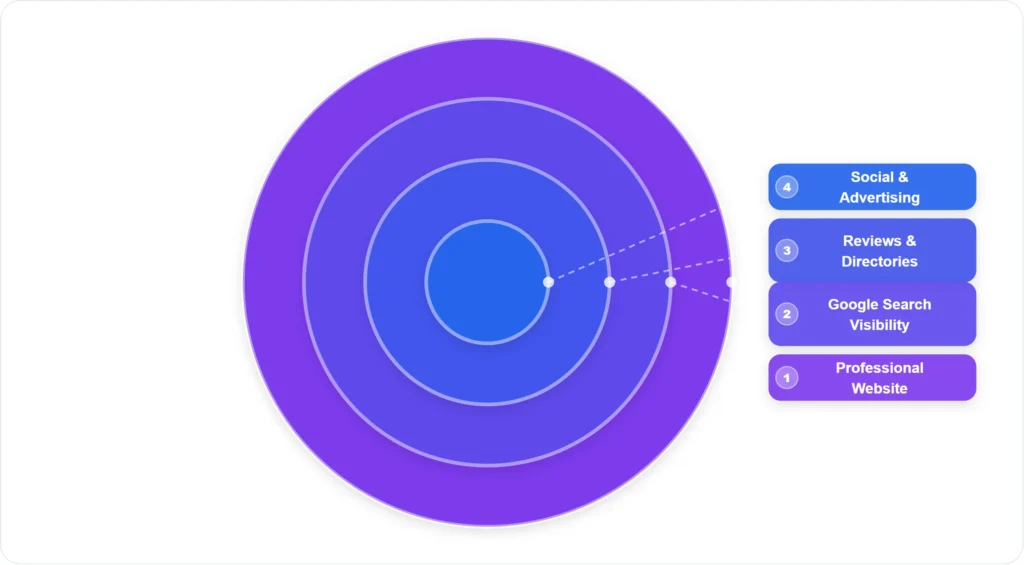
The Digital Presence Layers: Build From the Inside Out
- Social & Advertising: Instagram, LinkedIn, Google Ads, Meta Ads — amplify and extend reach once inner rings are solid
- Reviews & Directories: Google reviews, JustDial, Sulekha, citation consistency — builds trust signals and local authority
- Google Search Visibility: GBP, Search Console, local SEO, keyword-optimised content — makes you findable to active searchers
- Professional Website: Fast, mobile-responsive, conversion-optimised, analytics-enabled — the foundation that all other layers depend on
Step 6: Choose the Right Social Media Platforms (Not All of Them)
The biggest social media mistake Indian service businesses make is trying to maintain an active presence on Facebook, Instagram, LinkedIn, YouTube, and Twitter simultaneously — and doing all of them badly. Pick the 1 to 2 platforms where your clients actually spend time and do those well:
- B2B services (CA firms, HR consultants, corporate trainers): LinkedIn is your primary platform
- Consumer services with strong visual appeal (interior designers, wedding photographers, chefs, fitness trainers): Instagram
- Education and training institutes: YouTube (long-form tutorial content) + Instagram (quick tips)
- Local neighbourhood services (electricians, clinics, salons): Facebook Groups and local community pages
Step 7: When to Add Paid Advertising to Your Digital Presence
Paid advertising — Google Ads, Meta Ads — should be the last element you add, not the first. Add paid ads when:
- Your digital website is live, fast, and converting organic visitors into enquiries
- Your Google Analytics is set up and tracking conversions correctly
- You have at least 10 Google reviews establishing basic credibility
- You want to accelerate growth beyond what organic traffic alone can provide
For service businesses with a strong local presence and good reviews, Google Ads targeting “[your service] in [your city]” is typically the highest-ROI paid channel. Allocate ₹10,000 to ₹20,000 per month to test before scaling.
At ByteMinders Edutech, we build the complete digital presence for service businesses — from the professional website and local SEO setup to the content strategy and Google Ads management.
Frequently Asked Questions
Q1. How long does it take to build a strong digital presence from scratch?
A professional digital website can be live within 4 to 8 weeks. Google Business Profile optimisation takes 2 to 4 weeks to show impact. Building a meaningful review base (20+ reviews) takes 2 to 3 months with a systematic approach. Achieving consistent first-page Google rankings for your primary service keywords typically takes 4 to 9 months of SEO work. A complete, strong digital presence takes approximately 12 months of consistent effort — but the early stages deliver meaningful results well before that.
Q2. Can I build a digital presence without a professional website?
You can have a partial digital presence — a Google Business Profile, social media pages, and directory listings — without a website. Some businesses get initial traction this way. However, without a professional digital website, you have no owned digital asset, no SEO foundation, no place to direct advertising traffic, and limited ability to differentiate yourself from competitors. The ceiling on a website-free digital presence is very low.
Q3. What is the minimum monthly budget for maintaining a digital presence?
After the initial website build, a basic monthly digital presence maintenance budget for a small service business: ₹3,000 to ₹8,000 for website hosting, maintenance, and basic SEO. Your own time investment of 3 to 5 hours per month — for publishing one blog post, responding to reviews, and posting on one social media platform — provides the consistency that compounds organic results over time.
Q4. My competitors have strong digital presences. How do I catch up?
Start with what they are doing well and then find the gaps they have left open. Look at their Google reviews — how many do they have and what are clients saying? Check their website content — are there topics or services they have not covered? Examine their local directory presence — are there platforms they are not listed on? Competing with an established digital presence requires focus: do a smaller number of things more thoroughly and specifically than your competitors, rather than trying to replicate everything they have built over years.
Q5. How important is it to be active on social media for a service business?
For most local service businesses, social media is supplementary — not foundational. It builds brand awareness and maintains relationships with existing clients, but it rarely drives the volume of new client acquisition that a well-optimised Google presence does. Be consistent rather than impressive: one or two quality posts per week on the right platform for your audience will serve you better than daily posts that burn you out and produce minimal results.
Q6. Should I hire someone to manage my digital presence or do it myself?
For the initial build — professional website, GBP setup, and technical SEO — hiring a professional delivers significantly better results than DIY, especially for non-technical business owners. For ongoing management — review responses, social media posts, and blog content — many business owners successfully handle this themselves once the system is established. The most cost-effective model is often to hire professionals for setup and strategy, then manage day-to-day content yourself with periodic professional support for improvements.