
A website without a website content strategy is like a shop with no products on the shelves. It may look attractive, but there is nothing for visitors to engage with, nothing to answer their questions, and nothing to give Google a reason to send them to you instead of a competitor.
Content strategy is how you decide what to publish, for whom, in what format, and in what order — so that your website gradually builds authority, attracts relevant organic traffic, and converts visitors into leads and customers. It is not about publishing as much as possible. It is about publishing the right things, for the right people, at the right time.
This guide gives you a practical, step-by-step content strategy framework that works for Indian business websites of any size.
Why Your Website Content Strategy Determines Your Organic Traffic
Google’s job is to find the best answer to every search query. When someone searches “how to choose a CA firm in Delhi” or “best WordPress developer for schools in India”, Google looks across all indexed websites and ranks the ones that most comprehensively, accurately, and helpfully answer the question.
A well-planned website content strategy ensures that for the searches your potential customers are making, your website is the one with the best answer. This is how organic traffic is built — not through tricks or manipulation, but through consistently being genuinely useful to the right audience.
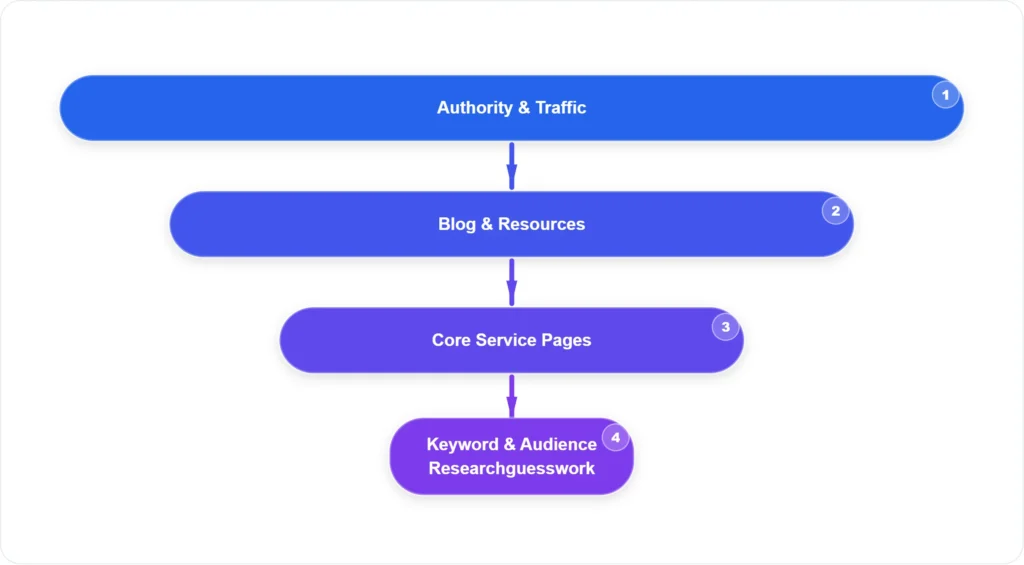
The Website Content Strategy Pyramid
- 🏆 Authority & Traffic: Consistent organic rankings, brand authority in your niche, and inbound leads from content — the business outcome that all layers below build toward
- ⭐ Blog & Resources: Regular blog posts, guides, case studies, and FAQs targeting long-tail keywords — the engine of compounding organic traffic growth
- ✅ Core Service Pages: Detailed, keyword-optimised pages for each service you offer — the conversion layer that turns traffic into enquiries
- 🔑 Keyword & Audience Research: Understanding exactly who your audience is, what they search for, and what content will answer their questions — without this, everything above it is guesswork
Step 1: Define Your Audience With Precision
Vague website content is written for everyone and resonates with no one. Before writing a single word, define your primary audience with as much specificity as possible:
- Who are they? (Age, profession, business size, location)
- What problem are they trying to solve?
- What do they already know about your topic?
- What language and vocabulary do they use?
- What objections or fears do they have about working with businesses like yours?
For example, a chartered accounting firm’s audience might be: “Small business owners in Tier 2 Indian cities, aged 30–50, who are confused about GST compliance and want clear, jargon-free guidance from someone they can trust.” Every piece of content they publish should speak directly to that person.
Step 2: The Content Audit — Know What You Have Before You Add More
If you have an existing website, audit what is already there before creating new content. Many businesses have pages that could perform much better with simple improvements — rather than needing new content from scratch.
For each existing page, assess:
- Is it targeting a specific keyword?
- Is the word count above 500 words for service pages, 1,000 words for blog posts?
- Is it indexed by Google? (Check in Google Search Console)
- Is it getting any organic traffic? What is its average ranking position?
- Does it have a clear call to action?
Pages already ranking in positions 11 to 20 (page 2 of Google) are the highest-priority targets for improvement — they need less effort to reach page 1 than creating entirely new content.
Step 3: Build Your Content Map
A content map is a structured plan of every piece of content your website will contain — both current and future. It shows the relationship between content types and ensures you have coverage at every stage of your audience’s decision journey.
| Content Type | Purpose | Target Keyword Type | Update Frequency |
|---|---|---|---|
| Homepage | First impression, brand authority, primary CTA | Brand + primary service keyword | Review every 6 months |
| Service Pages | Convert visitors researching your specific services | Mid-tail: [service] + [location/industry] | Review every 6 months |
| About Page | Build trust, humanise the brand, establish credibility | Brand + team keyword | Update as team/story evolves |
| Blog Posts | Attract organic traffic, answer audience questions, build authority | Long-tail informational keywords | 2–4 new posts per month |
| Case Studies | Social proof, demonstrate results, build conversion confidence | Industry + results keywords | Add after each major project |
| FAQ Page / Sections | Target question-based searches, reduce pre-sale objections | Question-based long-tail keywords | Update quarterly |
| Landing Pages | Convert paid traffic from specific campaigns | Campaign-specific keywords | Per campaign |
Step 4: The Blog Content Calendar — How to Build Consistent Organic Traffic
A blog is the most powerful long-term organic traffic engine for most business websites. But consistency matters far more than volume. Two thoughtful, well-researched posts per month published consistently for 12 months will dramatically outperform 20 rushed posts published in one month and then nothing.
For your blog content calendar, follow this planning framework:
- Theme each month: Focus each month’s blog content around a single topic cluster — for example, “eCommerce tips” in October before the festive season, or “tax planning” in January for CA firms
- Mix content types: Alternate between how-to guides, listicles, case studies, and opinion pieces to maintain audience interest and cover different keyword types
- Address every stage of the buyer journey: “What is X” posts for awareness; “How to choose X” for consideration; “Why us for X” for decision
- Repurpose strategically: Turn each blog post into a social media carousel, a short video script, or an email newsletter — extending the value of each piece of content without multiplying your effort
The Content Creation Cycle: Plan, Publish, Promote, Measure, Improve
- Research & Plan: Identify keyword opportunity, check competitor coverage, confirm audience need, plan structure
- Write & Publish: Create genuinely helpful, keyword-optimised content; format for readability; publish with all meta fields complete
- Promote & Share: Share on LinkedIn, Instagram, WhatsApp Business groups, and in your email newsletter; repurpose into other formats
- Measure & Analyse: Check Google Search Console for impressions, clicks, and average position after 4 to 8 weeks; check Google Analytics for engagement and conversion
- Update & Improve: Expand thin sections, add recent data, improve internal linking, update the publish date — then loop back to promotion. Google rewards freshness.
What Makes Website Content Actually Work: The EEAT Standard
Google evaluates content quality using EEAT: Experience, Expertise, Authoritativeness, and Trustworthiness. Strong website content must signal all four:
- Experience: Show that real people with real experience wrote this — include author bios, first-person insights, case studies from actual client work
- Expertise: Demonstrate deep knowledge — use accurate terminology, reference data, explain nuance rather than surface-level generalisations
- Authoritativeness: Be cited and linked to by other reputable sources — this is built over time through quality content and outreach
- Trustworthiness: Have accurate contact information, clear privacy policy, real reviews, and honest content that does not oversell or mislead
For a broader content and SEO strategy that covers the technical foundations, read our guide on on-page SEO for websites. And to understand how content fits into your overall digital marketing, our article on website development and digital marketing strategy provides the complete framework.
Frequently Asked Questions
Q1. How much website content do I need before launching a new site?
At minimum, your website should have a fully written homepage, individual pages for each core service, an about page, and a contact page before launch. Launching with placeholder or thin content is a missed opportunity — Google begins indexing your site from day one, and the quality of content on those first indexed pages sets the initial perception of your site’s authority. Aim for at least 500 words of genuine, useful content on every page before going live.
Q2. How long should a blog post be to rank on Google?
For most competitive topics, 1,500 to 2,500 words is the sweet spot — long enough to cover the topic comprehensively, not so long that you are padding for length. Some highly competitive topics reward 3,000+ words. Always research the top-ranking pages for your target keyword before writing — the average word count of those pages gives you a useful benchmark. Quality and comprehensiveness matter far more than hitting an arbitrary word count.
Q3. Should I write website content myself or hire a content writer?
Ideally, a combination: write the first draft yourself (because you know your business, clients, and industry best), then have a professional editor or content writer improve the structure, readability, and keyword optimisation. Pure AI-generated or outsourced content that has never been reviewed by a subject matter expert tends to lack the depth and specificity that Google’s EEAT standards increasingly reward. Your real insights and experience are the hardest things to replicate.
Q4. How often should I publish new blog content?
Consistency matters more than frequency. Two high-quality posts per month published reliably over 12 months will almost always outperform eight posts published in one month followed by silence. Set a publishing schedule you can genuinely maintain — even one post per month, done consistently, compounds into significant organic traffic over 12 to 18 months of effort.
Q5. Can I rank without a blog if my service pages are well-optimised?
Yes — in low-competition niches and for local searches, well-optimised service pages alone can rank reasonably well. However, a blog significantly expands the keyword surface area of your website, builds authority signals over time, and allows you to rank for the informational searches your potential customers make before they are ready to buy. Businesses that invest in blog content almost always outrank those that do not, given equal service page quality.