
Every month, a new set of digital solutions is promoted as the must-have tool for small businesses. AI chatbots, blockchain loyalty programmes, metaverse storefronts, NFT marketing — the noise is relentless. And in the middle of it all, the average Indian small business owner — a shop owner in Nagpur, a coaching institute in Bhopal, a chartered accountant in Surat — is trying to figure out what will actually help them grow.
This guide cuts through the noise. We separate the digital solutions that genuinely grow small businesses from the expensive distractions that sound impressive but deliver nothing, and we show you the order in which to invest for maximum return.
The Foundation First Rule: Not All Digital Solutions Are Equal
Before evaluating any specific tool or platform, understand one principle: digital solutions must solve a real problem your business has right now, not a theoretical problem you might have in the future.
Most small businesses that come to us have invested in the wrong things in the wrong order. They have an expensive CRM but no website for leads to come from. They have a social media manager running reels but no Google Business Profile to capture local search traffic. They have a WhatsApp Business account but no way to follow up systematically with enquiries.
The right order matters enormously. Digital solutions that build on each other produce compounding results. Digital solutions that skip foundational steps produce disappointing ones.
The Digital Solutions Priority Pyramid for Small Businesses
- 🏆 Automation & Scale: CRM systems, email automation, chatbots, advanced analytics — only valuable once Levels 1–3 are producing consistent results
- ⭐ Marketing & Content: Social media, Google Ads, content marketing, WhatsApp marketing — drives traffic and brand awareness to your online foundation
- ✅ Lead Capture Systems: Contact forms, WhatsApp Business, booking tools, enquiry tracking — converts visitors into leads you can follow up
- 🔑 Website & Google Presence: Professional website + Google Business Profile — without this, everything above it has nowhere to send people
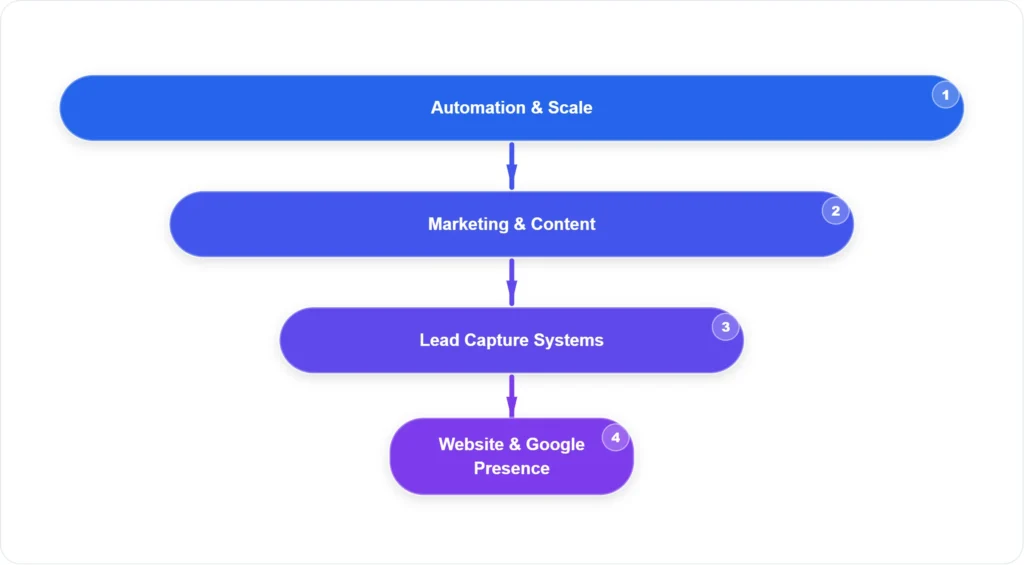
Invest in this order. Do not skip levels.
Tier 1: Essential Digital Solutions (Do These First)
1. Professional Business Website
A professional, fast, mobile-responsive website is the single most important digital asset any small business can have. It is available 24/7, builds credibility, generates leads, and supports every other digital activity. Without it, you have no owned digital presence — just rented space on platforms that can change their rules at any time.
Investment: ₹25,000 – ₹80,000 for a professionally built site. Read our guide on website development for small businesses for a complete cost and process breakdown.
2. Google Business Profile
Free to set up. Directly determines whether your business appears when someone searches “your service near me” or “your service in your city”. For any business that serves a local area, this is the highest-ROI digital activity available — and it costs nothing except your time.
Investment: Free. Time to set up: 2 to 3 hours. Time to optimise fully: 4 to 6 hours.
3. WhatsApp Business Account
India runs on WhatsApp. A properly set up WhatsApp Business account — with a business profile, automated greeting messages, quick reply templates, and a catalogue for your services — converts enquiries faster than any other communication channel for Indian small businesses.
Investment: Free. WhatsApp Business API (for larger businesses needing automation) starts at approximately ₹2,000 to ₹5,000 per month.
Tier 2: High-Value Digital Solutions (After Tier 1 Is Working)
4. SEO and Local Search Visibility
Once your website is live, investing in SEO — either through ongoing content creation and link building yourself, or through a professional digital solutions provider — is the most sustainable way to grow organic traffic. Unlike paid ads, good SEO continues to deliver value indefinitely.
Investment: ₹5,000 – ₹25,000 per month for professional SEO services; or 4 to 8 hours per month of your own time for basic SEO maintenance.
5. Google Ads (Pay Per Click)
Once you have a fast, conversion-optimised website and a basic analytics setup, Google Ads can deliver immediate, targeted traffic. It works best for service businesses with a clear service offering and reasonable average client value. Do not start Google Ads before your website is conversion-ready — you will spend money sending people to a page that does not convert.
Investment: ₹10,000 – ₹50,000 per month in ad spend, plus ₹5,000 – ₹15,000 for management.
6. Email Marketing
Email is the most cost-effective digital marketing channel with the highest average ROI globally. For Indian small businesses, a simple monthly newsletter to existing and past clients — sharing useful tips, updates, and offers — keeps your business top-of-mind at extremely low cost.
Investment: Free to ₹2,000 per month (Mailchimp, Zoho Campaigns) for up to a few thousand subscribers.
Tier 3: Situational Digital Solutions (Only If Your Specific Business Needs Them)
7. CRM (Customer Relationship Management)
A CRM becomes valuable when you have enough leads and clients that managing them in WhatsApp or a notebook is causing things to fall through the cracks. For most small businesses, this happens at 20 to 50 active client relationships. Before that threshold, a CRM adds complexity without proportional benefit.
Investment: Free tiers available in Zoho CRM, HubSpot CRM, and Freshsales. Paid plans from ₹1,500 to ₹6,000 per user per month.
8. Social Media Marketing
Social media is powerful for brand awareness and community building, but it is widely overestimated as a direct lead generation tool for local service businesses. A doctor’s clinic in Nashik will generate far more leads from Google Search and their Google Business Profile than from Instagram, regardless of how many reels they post.
Honest assessment: Maintain a professional presence, but do not invest heavily in social media until your search-based digital foundations (website, GBP, SEO) are delivering consistent results.
9. Online Booking and Appointment Systems
For businesses where appointments or bookings are the primary conversion — doctors, salons, consultants, coaching institutes, fitness trainers — an online booking system dramatically improves conversion rates from website visitors and reduces the administrative overhead of phone-based scheduling.
Investment: ₹1,500 – ₹8,000 per month for booking software; can also be built into your website as a one-time development cost.
Digital Solutions That Are Mostly Hype for Small Businesses Right Now
| Solution | The Hype | The Reality for Small Businesses |
|---|---|---|
| AI Chatbots | “24/7 customer service automation” | Useful for large businesses with high enquiry volume; for most small businesses, a well-structured WhatsApp auto-reply does the same job for free |
| Social Media Ads (Meta) | “Reach thousands for ₹500” | Can work for some B2C products; very poor ROI for most local service businesses compared to Google search-based advertising |
| App Development | “Your customers want an app” | Very few small business customers will download a dedicated app. A well-built progressive web app or mobile-optimised website does 90% of what an app does at a fraction of the cost |
| Influencer Marketing | “Go viral with one post” | Works for consumer products; rarely effective for local service businesses that need clients within their geography |
Your Digital Solutions Roadmap: Month-by-Month
- 📅 Month 1: Professional website goes live — mobile responsive, fast, SEO foundations in place
- 📅 Month 2: Google Business Profile fully optimised — photos, services, description, first review collection begins
- 📅 Month 3: WhatsApp Business properly configured — business profile, auto-replies, service catalogue
- 📅 Month 4: SEO content strategy begins — 2 blog posts per month, local keyword targeting on service pages
- 📅 Month 6: Google Ads trial campaign — test with ₹10,000 to ₹15,000 budget to validate PPC viability for your service
- 📅 Year 1: Evaluate whether CRM, booking system, or email automation will meaningfully improve an already-working lead generation system
At ByteMinders Edutech, we help businesses build their digital solutions stack in the right order — starting with what creates the most impact immediately, and adding complexity only when the foundation is solid. Contact us for a free digital audit.
Frequently Asked Questions
Q1. What is the single most important digital solution for a new small business?
A professional, mobile-responsive, SEO-ready website is the non-negotiable foundation. It is the only digital asset you truly own — your Google Business Profile, social media pages, and directory listings all reference back to it. Without a quality website, every other digital investment underperforms because there is no credible destination to send people to.
Q2. How much should a small business budget for digital solutions annually?
A practical starting budget for a small Indian business wanting meaningful digital presence: ₹50,000 to ₹80,000 for website development, ₹10,000 to ₹20,000 per year for hosting and maintenance, and ₹5,000 to ₹15,000 per month for SEO or content marketing once the site is live. Total first-year investment: ₹1,20,000 to ₹2,60,000 for a serious, results-oriented digital foundation.
Q3. Is social media essential for small business digital marketing?
It depends on your industry. For businesses targeting younger audiences, consumer products, or creative services, an active social media presence is genuinely valuable. For local service businesses — doctors, lawyers, accountants, tutors, contractors — search-based digital solutions (website, GBP, SEO, Google Ads) consistently deliver better ROI than social media marketing. Maintain a basic presence, but do not let social media consume the budget that would be better spent on search visibility.
Q4. How do I know which digital solutions provider to trust?
Look for a provider who starts with questions about your business goals before recommending solutions. A trustworthy digital solutions company will tell you what you do not need as clearly as what you do need. Ask for case studies of businesses similar to yours, verify their recommendations against your actual goals, and be cautious of anyone who leads with impressive-sounding technology rather than business outcomes. See our guide on how to choose the right website development company in India for detailed vetting advice.
Q5. Can small businesses compete with large companies digitally?
Yes — and local businesses often have a structural advantage. Large companies cannot hyper-localise their content and presence the way a small business can. A local physiotherapist in Nashik who properly implements local SEO, has 60 genuine Google reviews, and publishes helpful content about physiotherapy in their city will consistently outrank a national chain’s generic local page. The key is to compete on specificity and genuine local relevance rather than budget.