

Introduction
Link building remains one of the most powerful tools in a digital marketer’s SEO arsenal. But here’s the thing: not all link-building strategies are created equal. While some tactics promise quick wins, they often carry huge risks, including penalties from Google. That’s where white hat link building comes in—methods that are ethical, sustainable, and designed to improve your site’s authority over the long haul.
In simple terms, white hat link building is all about earning links the right way—through high-quality content, relationships, and strategic promotion—rather than buying or spamming links. Think of it as planting seeds in a garden: with patience and care, you get a thriving ecosystem rather than short-lived results.
In this guide, we’re going to explore 10 white hat link-building techniques that actually work. From guest blogging to using HARO, these strategies will not only boost your rankings but also enhance your credibility online. Whether you’re an SEO newbie or a seasoned marketer, implementing these strategies correctly can change the trajectory of your website’s organic growth.
By the end of this article, you’ll have a clear roadmap to attract high-quality backlinks, avoid penalties, and create content that naturally earns links. Let’s jump right in.
What is Link Building?
At its core, link building is the practice of acquiring hyperlinks from other websites to your own. Search engines like Google use these links to crawl the web and determine which pages deserve higher rankings. Essentially, links act like votes of confidence—each one signals that your content is valuable, trustworthy, or relevant.
But not all links are equal. Google looks at the authority and relevance of the linking website. A link from a high-authority site in your niche is far more valuable than dozens of links from unrelated, low-quality sites. That’s why focusing on quality rather than quantity is key in white hat link building.
Links can influence SEO in multiple ways:
- Boosting rankings: High-quality backlinks improve the likelihood of your page ranking for competitive keywords.
- Driving referral traffic: Links from relevant sites can send engaged visitors directly to your content.
- Building authority: When authoritative sites link to you, search engines see your website as trustworthy.
It’s also worth noting that link building isn’t just about SEO. A strong backlink profile enhances your brand visibility and establishes you as a thought leader in your niche. In the next sections, we’ll dive into actionable strategies to earn these links ethically.
Why White Hat Techniques Are Essential
You might be tempted to take shortcuts with black hat tactics—buying links, spamming forums, or using automated software. But search engines are smarter than ever, and these shortcuts can backfire. Black hat strategies may offer temporary gains, but they often lead to penalties, ranking drops, or even de-indexing.
White hat link building, on the other hand, focuses on long-term value. These techniques may require more effort, but the results are sustainable and compound over time. Here’s why you should prioritize white hat strategies:
- Avoid penalties: Google penalizes manipulative link schemes, which can significantly damage your site’s rankings. Ethical link building keeps your site safe.
- Enhance credibility: High-quality links from reputable sites establish your authority and trustworthiness in the eyes of both users and search engines.
- Long-term SEO benefits: Links earned through genuine outreach or valuable content continue to provide benefits over months and years, unlike paid or spammy links.
- Better user experience: Many white hat strategies, such as creating helpful resources or engaging content, improve your website for visitors, not just for bots.
In short, if your goal is sustainable SEO growth, white hat link building is non-negotiable. Now let’s break down the 10 actionable strategies that can help you build high-quality backlinks ethically.
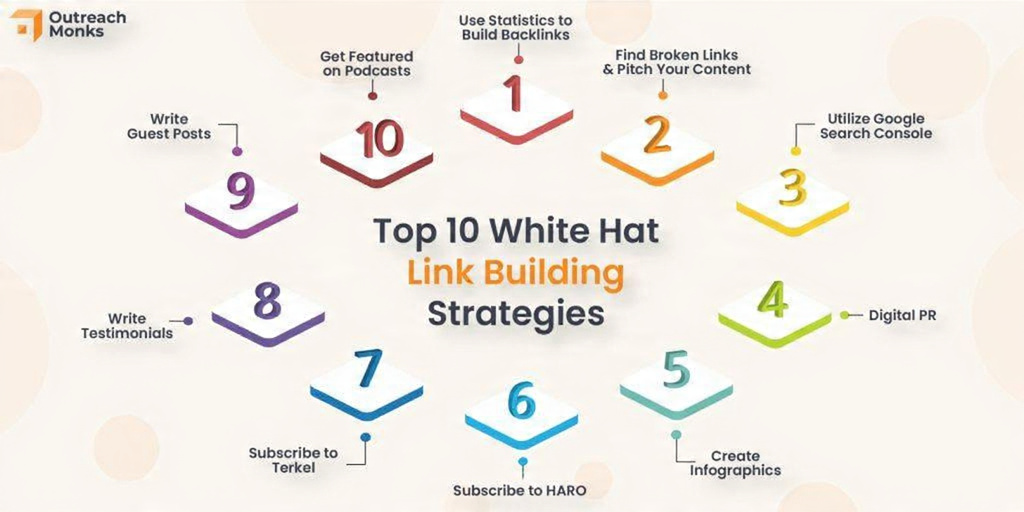
1. Guest Blogging for Quality Backlinks
Guest blogging remains one of the most effective white hat link-building strategies—but only if done right. It’s not just about dropping a link into someone else’s blog; it’s about providing genuine value to their audience.
Here’s how to approach it:
- Identify authoritative blogs in your niche: Look for blogs that have engaged audiences, high domain authority, and content relevant to your industry. Tools like Ahrefs or SEMrush can help you find these opportunities.
- Craft a compelling pitch: Focus on what value you’ll bring to their audience. Avoid generic pitches like, “Can I write for you?” Instead, propose specific topics that solve problems or provide unique insights.
- Write link-worthy content: Your guest post should be high-quality, informative, and engaging. Naturally, include a backlink to your site in a contextually relevant way—don’t force it.
- Follow up strategically: After publishing, share the post on your social media, tag the host, and engage with readers in the comments. This increases the post’s reach and the backlink’s impact.
2. Creating High-Quality, Link-Worthy Content
If there’s one link-building strategy that never goes out of style, it’s creating content that people actually want to link to. Think of it this way: links are like votes of trust, and people will only “vote” for content that is genuinely valuable. The key here is originality, usefulness, and engagement.
Types of content that attract backlinks:
- In-depth guides and tutorials: Comprehensive resources that answer questions thoroughly often earn links from bloggers, forums, and social media shares.
- Infographics: Visual content is highly shareable. If your infographic explains complex data clearly, websites are more likely to link back to it.
- Case studies and research: Original research provides unique insights others can reference. Data-driven posts often gain links because they are authoritative.
- Lists and resources: “Top 10 tools for X” or “Complete guide to Y” posts tend to be cited frequently.
Tips for creating link-worthy content:
- Focus on depth: Short, shallow posts rarely attract links. Aim for detailed content that answers multiple questions.
- Use visuals: Charts, graphs, screenshots, and videos increase shareability.
- Update regularly: Evergreen content that stays relevant over time tends to attract links continuously.
- Promote your content: Create shareable snippets, email your network, and engage communities where your target audience hangs out.
When you produce content that genuinely helps your audience, backlinks often happen naturally. Instead of chasing links, your strategy becomes creating value, and the links follow.
3. Broken Link Building
Broken link building is a clever technique that combines problem-solving with link acquisition. The idea is simple: find broken links on other websites, then suggest your content as a replacement. Not only does this help the website owner, but it also gives you a valuable backlink.
How to implement broken link building:
- Identify broken links: Use tools like Ahrefs, Screaming Frog, or Check My Links to find 404 pages on authoritative websites in your niche.
- Create or locate replacement content: Ensure the content you offer is as relevant or better than the broken page.
- Outreach politely: Send a friendly email explaining the broken link and suggest your content as a replacement. Keep it helpful rather than pushy.
Why it works:
- Website owners appreciate being notified about broken links—it saves them time.
- You provide genuine value, which increases the likelihood they’ll link to your page.
- It’s an ethical strategy aligned with Google’s guidelines.
Broken link building is time-consuming but highly effective. Think of it as helping someone fix a hole in their roof while leaving a small sign of your craftsmanship—everyone wins.
4. Resource Page Link Building
Resource pages are curated lists of helpful websites, articles, or tools around a specific topic. Being included on these pages is a high-quality backlink opportunity because these pages are usually authoritative and relevant.
How to approach resource page link building:
-
Find resource pages in your niche: Use search queries like:
- “Keyword + resources”
- “Keyword + useful links”
- “Keyword + curated list”
-
Evaluate the page’s quality: Ensure the site is authoritative and relevant. Avoid spammy or low-quality lists.
-
Reach out professionally: Send a concise email introducing your content and explaining why it would be a valuable addition to their resource page.
Resource pages are often overlooked but highly effective because these links are contextually relevant and trusted by both users and search engines. If your content genuinely adds value, this method can result in steady, long-term backlinks.
5. Skyscraper Technique
The skyscraper technique, popularized by Brian Dean, is a proven strategy to earn backlinks by improving upon existing content. The concept is straightforward: find content in your niche with lots of backlinks, create something better, and then promote it to the right audience.
Steps to implement:
- Research top-performing content: Use tools like Ahrefs or SEMrush to find pages with many backlinks.
- Create superior content: Make your post more comprehensive, updated, visually appealing, or easier to understand than the original.
- Outreach strategically: Contact websites linking to the original content and let them know about your improved version.
6. Leveraging Influencer Outreach
Influencer outreach is a powerful white hat link-building strategy that focuses on building genuine relationships with industry leaders. Rather than cold-link spamming, the goal is to connect with influencers who can naturally endorse or share your content.
How to find the right influencers:
- Use social media platforms: LinkedIn, Twitter, and Instagram are great for discovering influencers relevant to your niche.
- Check engagement, not just followers: A micro-influencer with 10,000 highly engaged followers may be more effective than someone with millions of passive followers.
- Follow and interact: Comment on their posts, share their content, and engage in discussions before pitching your content.
Outreach strategy:
- Personalized emails: Avoid generic outreach. Mention specific pieces of their work that you admire and explain how your content complements theirs.
- Offer value first: Provide insights, free resources, or co-creation opportunities to make the relationship mutually beneficial.
- Be patient: Building credibility takes time, but the results often include not only backlinks but social mentions and collaborations.
Influencer outreach works because people link to content they trust and respect. By nurturing these relationships, your content gains visibility and authority in a natural, ethical way.
7. HARO (Help a Reporter Out) Strategy
HARO is a goldmine for high-quality backlinks. It connects journalists with sources for their stories. By responding to relevant queries, you can secure authoritative media mentions and backlinks.
How to make HARO work for you:
- Sign up as a source: HARO emails daily opportunities from journalists across niches.
- Respond quickly: Timing is critical; journalists often work on tight deadlines.
- Craft concise, expert responses: Provide clear insights, data, or quotes that journalists can use directly.
- Track mentions: Use alerts or tools like Google Alerts to see where your responses are published.
HARO backlinks are particularly valuable because they come from high-authority media sites. Even one link from a major publication can boost your domain authority and referral traffic significantly.
8. Building Internal Links Strategically
While external backlinks are crucial, internal linking shouldn’t be overlooked. Proper internal linking helps search engines understand your site’s structure and distributes authority across pages.
Best practices for internal linking:
- Use descriptive anchor text: Avoid generic phrases like “click here.” Instead, use keywords that describe the linked page.
- Link to relevant content: Internal links should add value to the reader, guiding them to related topics.
- Prioritize important pages: Ensure high-priority pages like product pages or cornerstone content receive more internal links.
- Avoid excessive linking: Too many internal links can dilute the value and confuse readers.
Internal linking strengthens your site’s SEO overall and often leads to better user engagement. It’s a subtle but highly effective form of link building that works hand-in-hand with external strategies.
9. Competitor Backlink Analysis
Analyzing competitor backlinks is like peeking into the blueprint of their SEO success. By understanding where competitors get their links, you can replicate high-quality opportunities for your own site.
Steps for competitor backlink analysis:
- Identify top competitors: Use search engines or SEO tools to find websites ranking for your target keywords.
- Analyze backlink profiles: Tools like Ahrefs, SEMrush, or Moz reveal which sites link to competitors and the type of content being linked.
- Evaluate link quality: Focus on relevant, authoritative links rather than spammy sources.
- Outreach or content creation: Once you identify opportunities, reach out with similar or better content, or create new resources targeting the same websites.
10. Social Media & Community Engagement
Social media and online communities aren’t just for brand awareness—they can be powerful tools for earning backlinks naturally. Engaging with relevant communities positions you as an authority and encourages others to reference your content.
How to leverage social platforms for link building:
- Join niche-specific communities: Platforms like Reddit, Quora, LinkedIn groups, and industry forums host discussions where your expertise can shine.
- Provide value first: Don’t spam links. Answer questions, provide insights, and share resources naturally. Over time, users will reference your content voluntarily.
- Share your content strategically: Instead of posting blindly, target discussions where your content solves a problem or adds value.
- Encourage sharing: Make your content easy to share with clear social buttons and snippets that communities can use.
This strategy works because backlinks earned through engagement are contextual and user-driven, making them more authoritative in Google’s eyes. It also strengthens your online presence beyond just search rankings.
Common Link Building Mistakes to Avoid
Even with the best strategies, beginners often fall into traps that can hurt their SEO. Avoid these common mistakes:
- Over-optimization: Stuffing keywords into anchor text looks unnatural and can trigger penalties.
- Irrelevant links: Linking from unrelated sites adds little value and can harm rankings.
- Buying links: Paid links are risky and violate Google’s guidelines.
- Neglecting quality: Quantity doesn’t beat quality. A few authoritative links are far more valuable than dozens of low-quality ones.
- Ignoring relationship-building: Link building is a long-term strategy. Focusing only on immediate results limits your potential.
By avoiding these mistakes, you ensure your link-building efforts remain effective, sustainable, and ethical.
Measuring Link Building Success
Link building isn’t just about acquiring links—it’s about tracking impact. Here’s how to measure your efforts:
Key metrics to monitor:
- Domain Authority (DA): A higher DA often correlates with better search performance.
- Referral traffic: Check analytics to see how much traffic comes from backlinks.
- Search rankings: Monitor if targeted keywords improve after acquiring links.
- Number of quality backlinks: Focus on relevance and authority, not just total links.
Tools for tracking:
- Ahrefs: Comprehensive backlink and competitor analysis.
- SEMrush: Link audits, outreach tracking, and competitor insights.
- Google Search Console: Monitor links pointing to your site.
By regularly measuring these metrics, you can refine your strategies, focus on what works, and cut out low-impact efforts.
Future of Link Building
The world of SEO is constantly evolving, and link-building tactics must adapt. Google increasingly values relevance, trust, and E-A-T (Expertise, Authority, Trustworthiness) over sheer link quantity.
Trends to watch:
- Content-driven links: High-quality, original content will continue to attract natural backlinks.
- Brand mentions and citations: Even unlinked brand mentions can contribute to SEO authority.
- AI-assisted research and content creation: Using AI to identify link opportunities and produce content efficiently, while maintaining originality, will become standard.
Investing in ethical, relationship-driven link building now will pay dividends in the future as search engines continue to prioritize quality and user-focused experiences.
Conclusion
Link building isn’t just about SEO; it’s about building trust, authority, and long-term visibility. From guest blogging and HARO outreach to social engagement and competitor analysis, each white hat technique offers sustainable growth for your website.
The key takeaway: focus on quality, relevance, and relationships rather than shortcuts. When you prioritize value for users and search engines, backlinks naturally follow—and your rankings, traffic, and authority improve organically.
By implementing the 10 strategies outlined here, you’re setting your website up for long-term SEO success that withstands algorithm updates and boosts your credibility in your niche. Start small, stay consistent, and watch your backlink profile grow!
FAQs
-
What is the difference between white hat and black hat link building?
White hat link building uses ethical, sustainable strategies to earn links naturally, while black hat relies on manipulative tactics that can lead to penalties. -
How long does it take for backlinks to impact SEO?
Generally, backlinks may start showing impact within 2–6 months, depending on link quality, site authority, and content relevance. -
Can small websites benefit from link building?
Absolutely. Even a few high-quality backlinks can significantly improve rankings, traffic, and credibility for smaller websites. -
Is guest blogging still effective in 2026?
Yes, when done correctly. Focus on providing genuine value, building relationships, and linking naturally rather than over-optimizing. -
What tools are best for tracking backlinks?
Popular tools include Ahrefs, SEMrush, Moz, and Google Search Console for monitoring link profiles and tracking performance.