
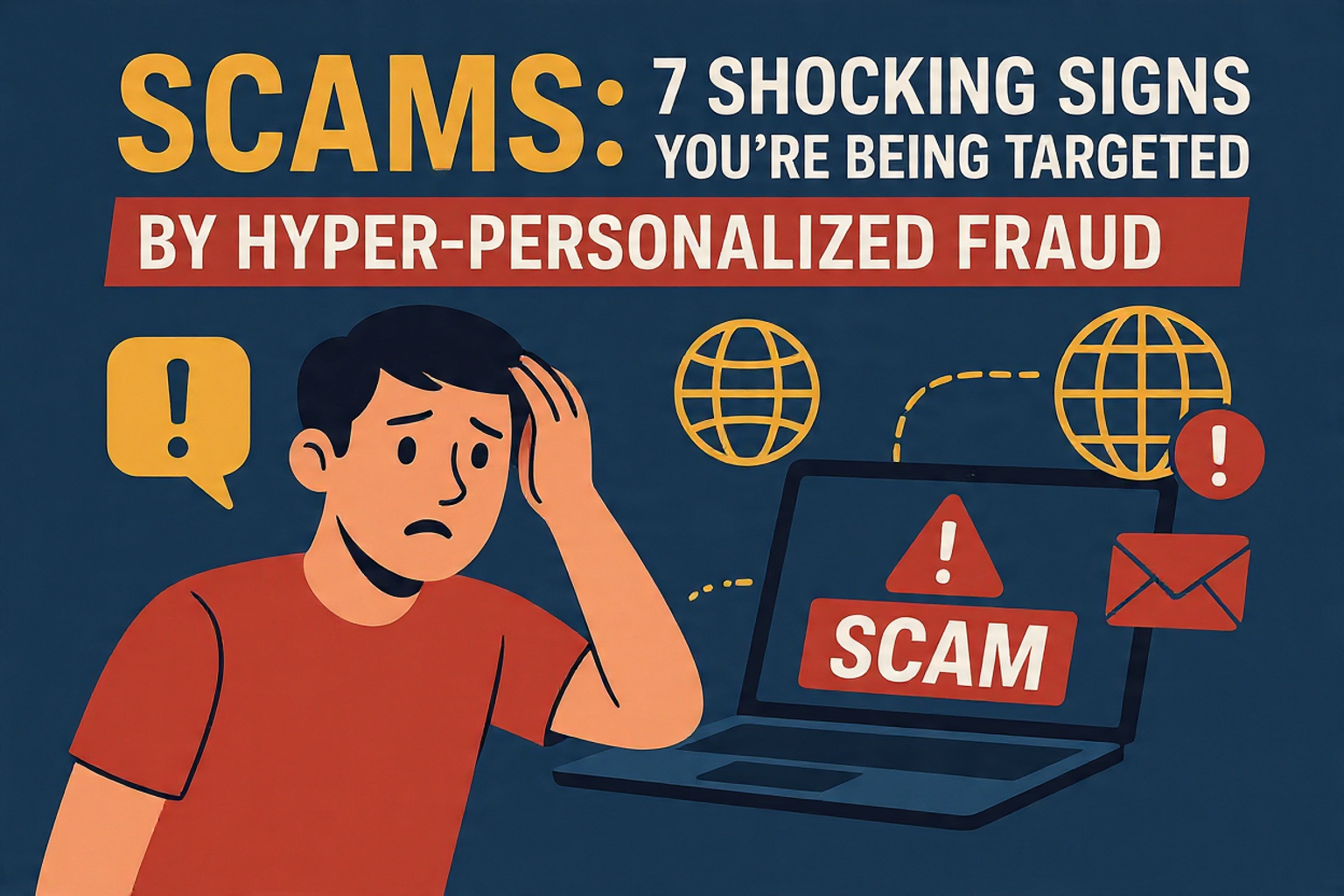
Scams are evolving fast, and hyper-personalized fraud now uses your own data to deceive you. These seven shocking signs will help you spot the danger before you become the next target.
They Knew My Order: The Shocking Reality of Hyper-Personalized Scams (and How to Fight Back)
Published: August 21, 2025 | Varanasi, Uttar Pradesh
Imagine this. You’ve just paid your electricity bill online. Later that day, you receive a message on WhatsApp from an unknown number displaying the official logo of your electricity provider. “Dear Customer,” it reads in Hindi, “Your last payment was not successfully processed. To avoid a power cut, please click on the link below and re-verify your payment details immediately.”
Your heart skips a beat. You remember making the payment, but a seed of doubt is planted. The message looks official, uses your city’s provider’s logo, and feels worryingly specific in its warning. It feels personal.
This isn’t a coincidence. This is the chillingly effective world of hyper-personalized scams. They are no longer the generic, easy-to-spot messages of the past. Modern fraudsters are like skilled investigators, piecing together the fragments of our daily lives to craft traps that feel frighteningly real and target our specific vulnerabilities. This guide will illuminate how they do it with real-life stories, explain why these personalized attacks are so potent, and arm you with simple yet powerful strategies to shield yourself in this evolving landscape of digital deception.
The Human Element: Why These Scams Feel So Real
Before we dissect the scams themselves, we must understand the battlefield: the human mind. Scammers don’t just exploit technology; they exploit our predictable human psychology. Their attacks are designed to bypass our rational thought and trigger an immediate, emotional response.
- The Hijacking of Trust: Our brains are built on mental shortcuts. One of the most powerful is “familiarity equals safety.” When a scam message contains details that are true and specific to our lives—our name, a recent purchase, our manager’s name—it feels familiar. This familiarity acts like a key, unlocking our trust and disabling our natural skepticism. We lower our guard because our brain tells us, “This must be legitimate; how else would they know that?”
- The Weaponization of Urgency: Every effective scam creates a sense of crisis. “Your power will be cut off,” “Your account will be frozen,” “This is the last chance.” This urgency floods our system with stress hormones, forcing us into a panic mode where we are driven to act immediately to resolve the threat. In this state, we don’t think logically; we react emotionally, which is exactly what the scammer wants.
- The Authority Bias: We are socially conditioned to respect and obey figures of authority—a bank official, a government agent, a company’s HR department. Scammers skillfully wrap themselves in the cloak of authority, using official logos, professional language, and a confident tone to make their demands seem non-negotiable.
Understanding these psychological triggers is your first line of defense. When you receive a message that makes you feel rushed, scared, or overly excited, it’s a sign to stop, breathe, and engage your logical mind.
A Gallery of Deception: Real-World Case Studies
These attacks are not theoretical. They are happening every day in our communities, targeting people from all walks of life.
Case Study 1: The Delivery Scam That Knew Too Much
Priya, a young professional in Varanasi, ordered an expensive designer handbag from an online boutique. Two days later, she received a WhatsApp message that looked exactly like it came from the courier company.
It read:
“Hi Priya, your package containing the [Exact Handbag Brand] from [Retailer Name] is stuck at the Varanasi hub due to a ₹75 customs clearance fee. Please pay via this UPI link to ensure same-day delivery.”
The message included her name, product details, and retailer name—everything matched perfectly. Trusting it, she paid the small fee.
Immediately afterward, she received a call from a supposed “delivery agent” who claimed there was a server error. He convinced her to install a remote-access app. Within minutes, her bank account was emptied.
The scam succeeded because the hyper-personalized details made everything feel genuine and believable.
Case Study 2: The “Help a Friend” Plea That Knew Too Much
Ramesh, a retired school teacher in Lucknow, received a Facebook message from an account that looked exactly like the profile of his former student, Priya.
The message said:
“Uncleji, I’m in a terrible situation in Mumbai! My phone was stolen, and I urgently need ₹5,000 via Paytm to book a train ticket back home. Please help!”
The familiar “Uncleji” and the fact that Priya lived in Mumbai made the request feel genuine. Ramesh was about to send the money.
But then he remembered something important: Priya had recently mentioned a family vacation to Kerala. Confused, he called her father—who confirmed she was safe.
The scammer had cloned Priya’s profile and used a small piece of public information (their relationship) to manipulate Ramesh’s kindness.
Case Study 3: The “Government Scheme” That Spoke Your Language
Seema, a homemaker near Patna, saw a sponsored Facebook post for a new “Digital India Initiative” scheme offering financial aid to women entrepreneurs. The post used official-looking logos and was written in perfect Hindi. It led to a website that was a convincing replica of a government portal, asking for her Aadhaar number, bank details, and mother’s name to “verify her eligibility.” Believing it to be a real government program tailored to her demographic, she provided all her information, only to find her bank account compromised days later.
The Scammer’s Research Department: How They Build a File on You
How do scammers gather these personal details? They act like intelligence analysts, collecting data from multiple sources to build a surprisingly accurate profile of their targets.
- Your Digital Diary: The Social Media Goldmine
Your public social media profiles are a treasure trove of information. Scammers can learn your full name, birthday, hometown, workplace, job title, family members’ names, and even your daily routines from your posts, photos, and check-ins. A simple post celebrating a new job on LinkedIn gives them the company name they need to craft a fake HR email.
- The Underworld’s Library: Data Breaches
When a large company you’ve used—an e-commerce site, an airline, a food delivery app—gets hacked, your data is often stolen. This information, including your name, email, phone number, and purchase history, is then sold on the dark web. Scammers buy these lists, which is how they can send a delivery scam message that correctly names the product you just ordered.
- The Open Book: Public Records and Simple Searches
A significant amount of information is publicly available through simple Google searches (a technique known as Open-Source Intelligence, or OSINT). A determined scammer can often find details about you and your family without any hacking at all.
- The Invisible Web: Cookies and Data Trackers
As you browse the internet, websites plant small files called cookies on your device. These, along with other trackers, build a detailed profile of your interests, shopping habits, and online behavior. This data is often sold to advertisers and, in some cases, can leak into the hands of fraudsters, who use it to target you with highly relevant scam advertisements.
Building Your Digital Fortress: A Proactive Defense Plan
You don’t need to live in fear. By taking proactive steps, you can turn yourself from an easy target into a well-defended fortress.
- The Mindset Shift: From Trusting-by-Default to “Verify, Then Trust”
The most important change is a mental one. In the digital world, your default setting should be a healthy skepticism. Treat all unsolicited messages—whether via email, SMS, or social media—as potentially suspicious until you can prove otherwise. This mindset is your first and strongest wall.
- The 5-Minute Privacy Audit: Drawing Your Digital Curtains
Take five minutes, right now, to review the privacy settings on your most-used social media accounts.
-
- Set Your Profile to Private: This is the single most effective step. It limits who can see your posts to only the people you have approved.
- Limit Who Can See Your Friends List: This prevents scammers from seeing your network of connections.
- Disable Location Tagging: Turn off automatic geotagging on your phone’s camera to stop broadcasting your location.
- Approve Tags Manually: Enable the setting that lets you review any photos you are tagged in before they appear on your profile.
- The Unbreakable Lock: Mastering Two-Factor Authentication (2FA)
If you do only one technical thing, make it this. 2FA is like adding a second, high-security lock to your front door. Even if a scammer steals your password (the first key), they cannot get in without the unique, time-sensitive code that is sent only to your phone (the second key). Enable it on your email, social media, and banking apps.
- The Safe Word System: An Old-School Trick for New-School Scams
For deepfake voice scams, technology can be defeated with a simple, human touch. Agree on a secret “safe word” or a quirky question with your close family members. If you ever receive a frantic call asking for money, you can ask for this word. A real family member will know it; an AI clone will not.
Code Red: Your Step-by-Step Guide for When You’ve Been Scammed
If the worst happens, do not blame yourself. These scams are designed to fool smart, careful people. Act quickly and methodically.
- The Golden Hour – Call 1930 Immediately: This is India’s National Cyber Crime Helpline. If you’ve lost money, your first call should be here. Reporting a fraudulent transaction within the first few hours (the “golden hour”) gives authorities the best chance to freeze the transaction and trace the funds.
- Lock Down Your Accounts: Immediately call your bank’s official fraud department. Report the fraudulent transaction and ask them to freeze your card, block your account, and reverse the charge if possible.
- Gather Your Evidence: Before you delete anything, take clear screenshots. Capture the scammer’s profile, the entire chat history, any fake documents they sent, and the transaction details (transaction ID, date, time).
- File a Formal Complaint: Go to the National Cyber Crime Reporting Portal at cybercrime.gov.in and file a detailed report. Upload all the evidence you gathered. This creates an official record that is crucial for any legal investigation.
- Warn Your Network: Inform your friends and family about the scam. This serves two purposes: it prevents them from becoming the next victims, and it provides you with a crucial support system.
- Address the Emotional Toll: Being scammed is a traumatic and violating experience. It’s normal to feel angry, embarrassed, or scared. Talk about it with someone you trust. Remember that you were the victim of a sophisticated crime.
Conclusion: From Potential Target to Empowered Guardian
The rise of hyper-personalized scams is a formidable challenge, but it is not an unbeatable one. The scammers’ entire strategy is built on a foundation of our own predictable human nature. By understanding their psychological tricks and the digital trails we leave behind, we can learn to outsmart them.
The goal is not to disconnect from the wonderful world of online community but to engage with it more wisely. Every time you pause before you click, every time you make a quick verification call, every time you review your privacy settings, you are strengthening your digital fortress.
You have the power to protect your digital life. Stay informed, stay skeptical, and turn your awareness into your unbreakable shield.
FAQ
1. What are scams on social media?
Scams on social media are fake schemes designed to trick users into giving money, data, or personal information.
2. How can I spot online scams quickly?
You can spot scams by noticing red flags like urgent messages, unknown links, or offers that look too good to be true.
3. Why are scams increasing every year?
Scams are increasing because scammers use advanced tech and social engineering to target more people easily.
4. How do scams steal personal information?
Scams often steal information through phishing pages, fake profiles, or malicious links.
5. Can scams be avoided with privacy settings?
Yes, strong privacy settings can reduce scams by limiting what scammers can see about you.
6. What should I do if I fall for scams online?
If you fall for scams, immediately change passwords, report the account, and contact your bank if needed.
Official Links for Reporting Scams